

Wopisanje
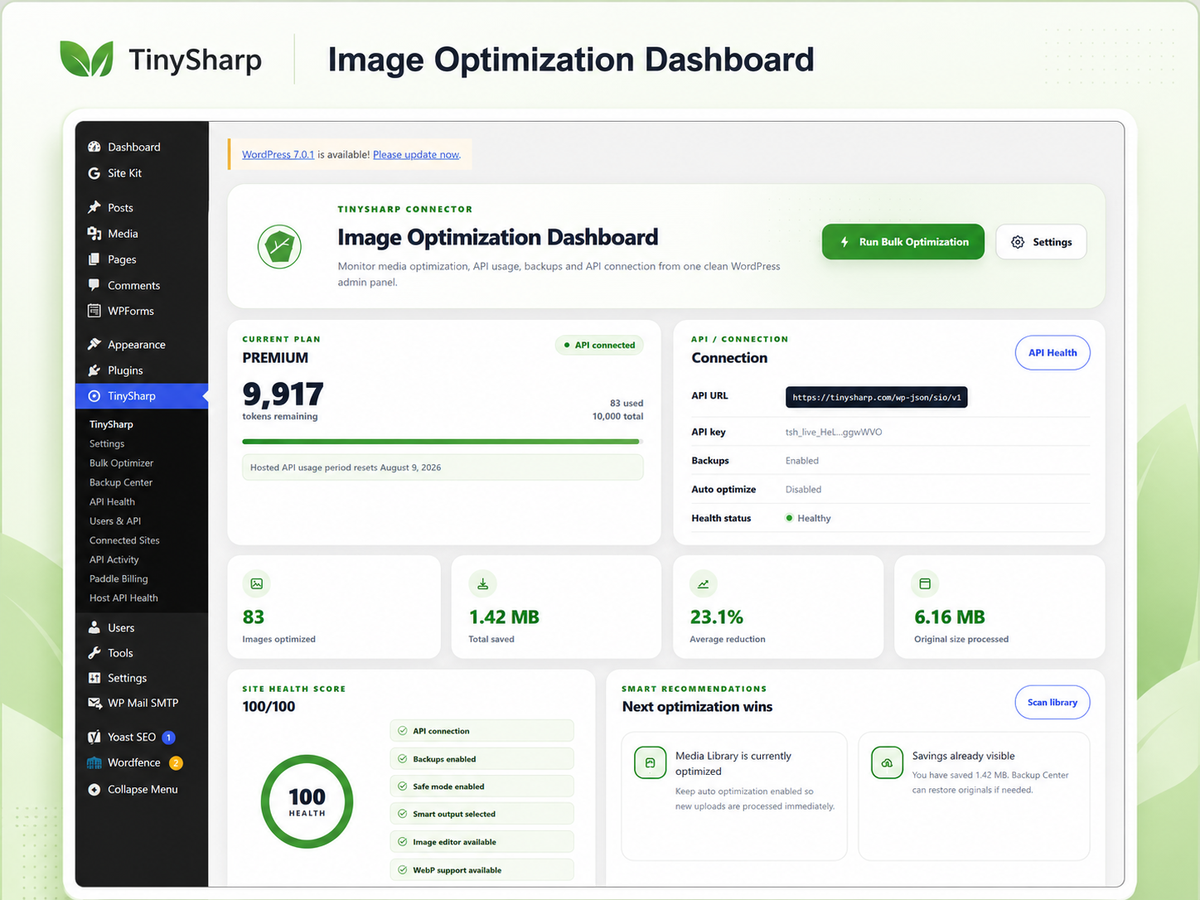
TinySharp Image Optimizer Connector helps WordPress site owners compress, resize, convert and deliver Media Library images with a production-safe workflow. It is built for teams that want smaller image files, WebP/AVIF support, bulk optimization, backups, restore controls and a clear admin dashboard without guessing what happened to each file.
The WordPress.org build includes local optimization tools, bulk optimization, backup records, restore controls, safe-mode settings and frontend image delivery controls without a license key. Connecting the optional TinySharp API adds hosted processing, account usage reporting and shared TinySharp usage across the website tools, the WordPress connector and the browser extension.
What TinySharp optimizes
- WordPress Media Library image attachments
- Existing uploaded images through the bulk optimizer
- New uploaded images when auto-optimization is enabled
- Main attachment files and generated image sizes where the server supports the selected format
- WebP variants for frontend delivery when enabled and supported by the server
Main features
- Image Optimization Dashboard with local savings and API status
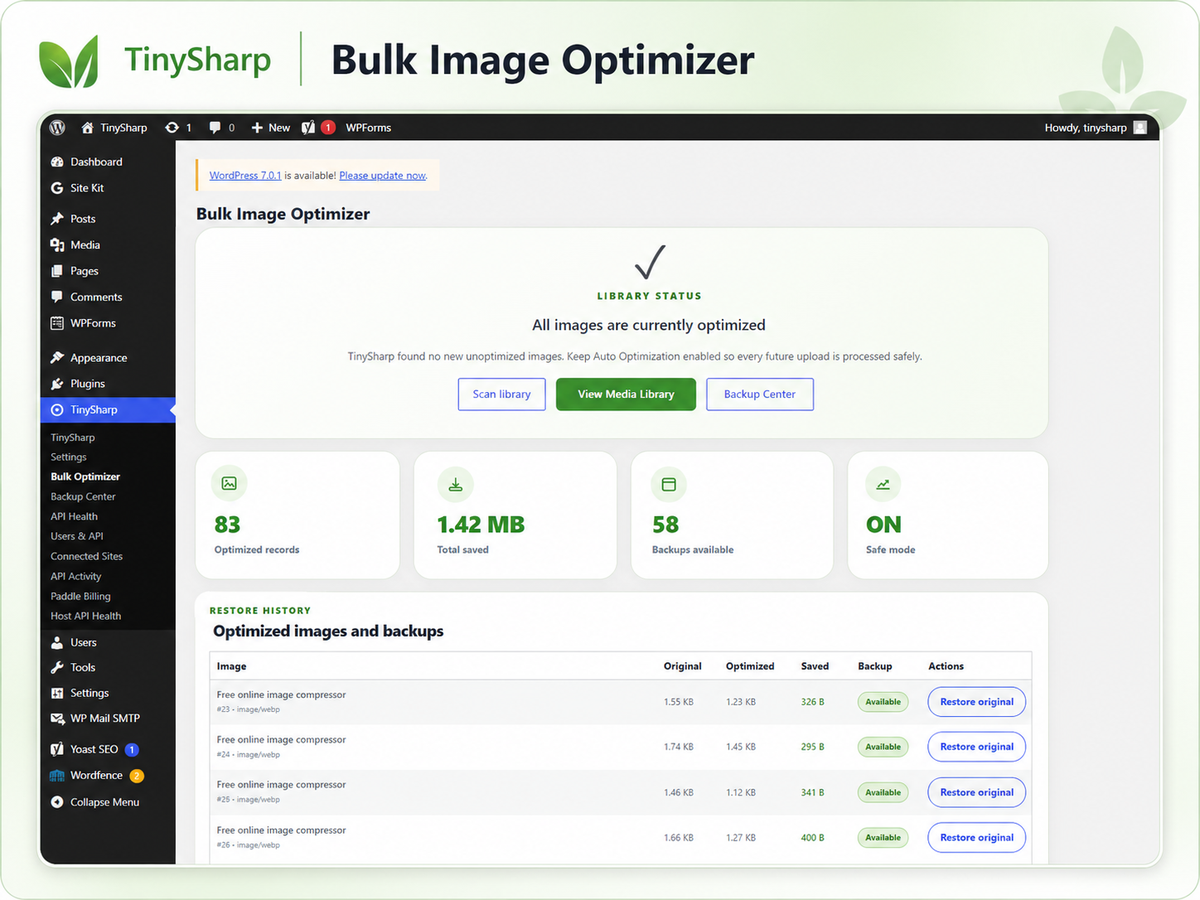
- Bulk Image Optimizer for existing Media Library images
- Automatic optimization on upload when enabled
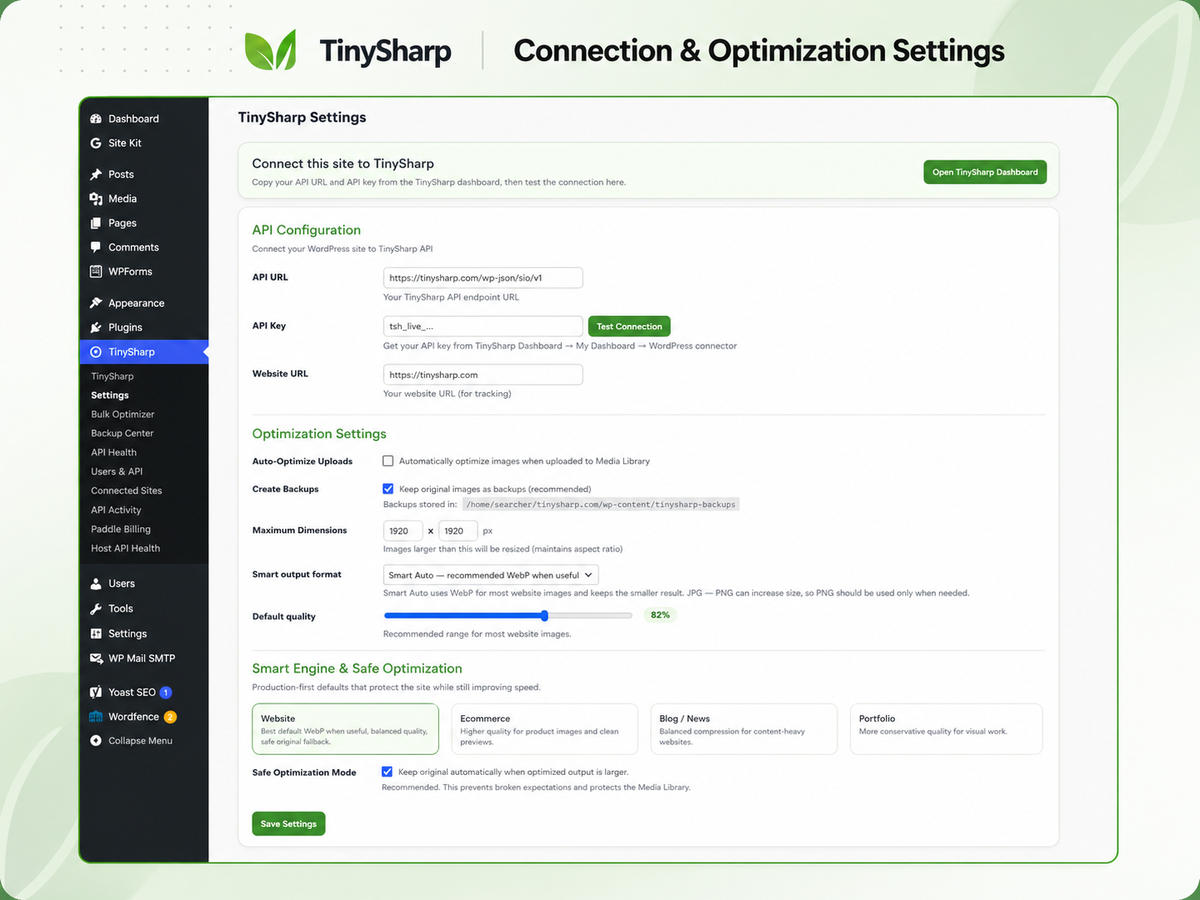
- Safe replacement: keep the original when the optimized output is larger
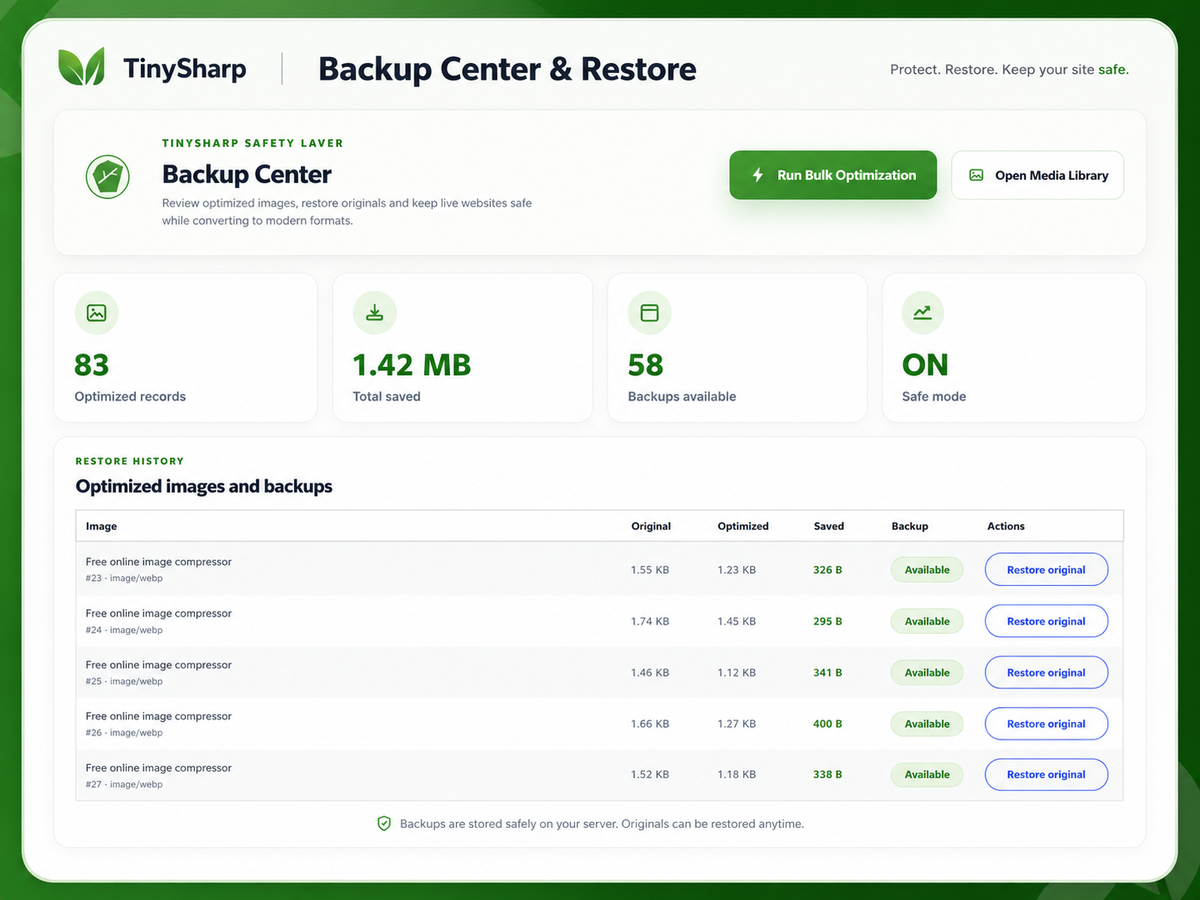
- Backup Center with restore controls for originals
- WebP conversion support when the server image editor supports it
- AVIF support when available in the server/API image environment
- Frontend Image Delivery for WordPress-generated attachment image URLs
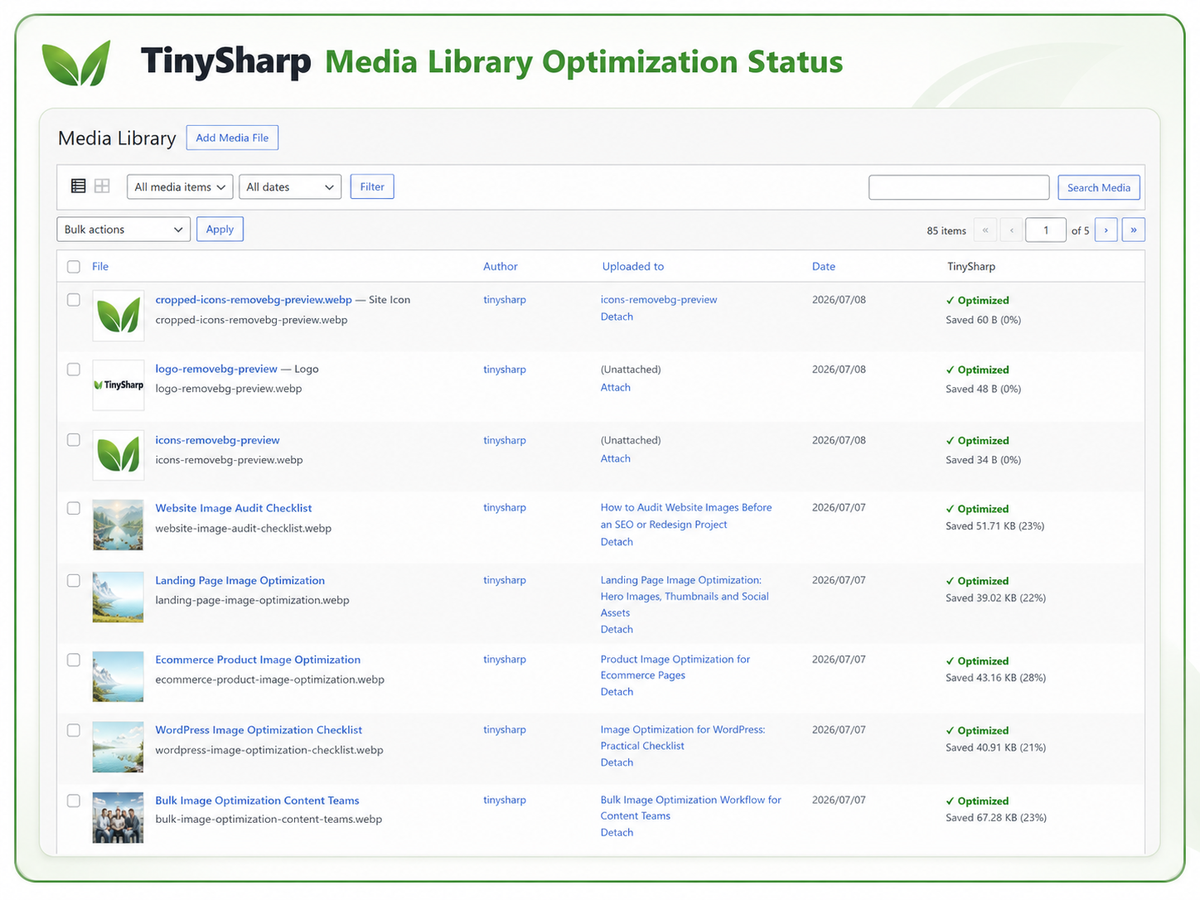
- Media Library optimization status column
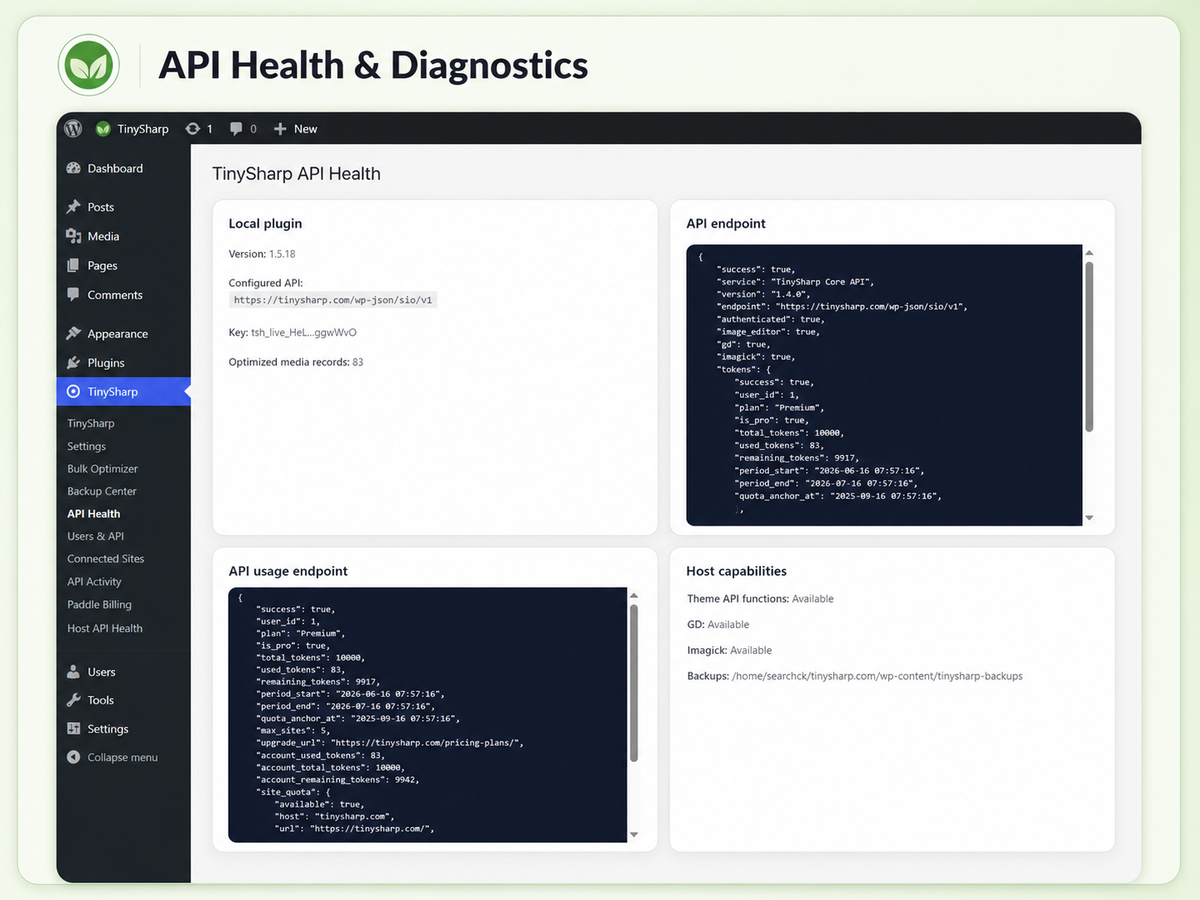
- API Health screen for troubleshooting
- Optional TinySharp API connection for hosted processing and usage reporting
Frontend image delivery
Optimizing an image file in the Media Library does not always mean the public theme will immediately serve the optimized version. Some themes, page builders, caches and CSS background images can keep printing old URLs.
TinySharp 1.6.0 adds a dedicated Frontend Image Delivery section in TinySharp > Settings. When enabled, TinySharp rewrites WordPress-generated attachment image URLs to local WebP/AVIF variants only when those files exist. This avoids global HTML rewriting and keeps the first delivery version predictable for production websites.
Important notes:
- WordPress-generated attachment images can be rewritten to optimized local variants.
- Hardcoded image URLs and CSS background images may need a theme, cache or page-builder refresh.
- TinySharp does not rewrite unrelated page content or monitor browsing activity.
- If frontend delivery is off, optimized files can exist in Media Library while the public site still displays original URLs.
Local tools and optional API access
Built-in local optimization, bulk optimization, backups, restore controls, safe-mode settings and frontend delivery controls are available without a license key. A TinySharp account and API key from https://tinysharp.com/ are optional and are used only when you choose to connect to the hosted TinySharp API service for server-side processing and account usage reporting.
External service disclosure
This plugin connects to the TinySharp API service at:
https://tinysharp.com/wp-json/sio/v1
The plugin connects to this service when you configure an API key and then test the API connection, check API usage status, or choose hosted API processing for optimization.
Data that may be sent to TinySharp:
- Image files selected for optimization
- Your configured TinySharp API key
- Site URL
- Plugin version
- Requested output format and quality settings
- Basic optimization metadata such as file size and savings
Purpose of the connection:
- Authenticate the WordPress site with the TinySharp account
- Process selected images for compression or conversion
- Return optimized image data
- Track hosted API usage and connected site activity
- Show API health information inside WordPress
TinySharp service terms: https://tinysharp.com/terms-of-service/
TinySharp privacy policy: https://tinysharp.com/privacy-policy/
No image is sent to the TinySharp API until the site administrator configures an API key and explicitly starts an optimization action or enables automatic optimization.
Privacy
TinySharp Image Optimizer sends selected images and optimization metadata to the TinySharp API only when the API key is configured and API processing is requested. Local optimization and frontend delivery controls operate on files inside the WordPress installation. See the External service disclosure section for details. Review the TinySharp privacy policy at https://tinysharp.com/privacy-policy/.
Support
For support, visit https://tinysharp.com/contact-support/ or email support@tinysharp.com.
Fota wobrazowki
Instalacija
- Install TinySharp Image Optimizer Connector from Plugins > Add New, or upload the plugin ZIP.
- Activate the plugin.
- Open TinySharp > Settings.
- Keep backups and Safe Optimization Mode enabled for production sites.
- Choose Smart Auto/WebP/AVIF output depending on your server support.
- Run a small test from Media Library or TinySharp > Bulk Optimizer.
- Enable Frontend Image Delivery only after checking that your theme and cache serve the expected output.
- Optional: connect your TinySharp API URL and API key if you want hosted processing and account usage reporting.
HSP
-
Do I need a TinySharp account?
-
No for the built-in WordPress plugin tools. Local optimization, bulk optimization, backups, restore controls, safe mode and frontend delivery controls are available without a TinySharp account. A TinySharp API key is optional and is used only for hosted TinySharp processing and account usage reporting.
-
Are images sent to an external server?
-
Only when you configure a TinySharp API key and choose hosted API processing. Built-in local optimization uses the WordPress/server image editor. See the External service disclosure section for details.
-
Why do I still see the original image URL on the public site?
-
Media Library optimization and frontend delivery are separate steps. If a theme, cache, page builder or CSS background image prints the original URL, visitors may still receive that URL until frontend delivery is enabled, cache is cleared, or the theme output is refreshed. TinySharp 1.6.0 adds settings to create local WebP/AVIF variants and serve them for WordPress-generated attachment image output when possible.
-
Can I restore original images?
-
Yes, when backups are enabled and a backup record is available. Use TinySharp > Backup Center to restore originals from stored backups.
-
Does TinySharp replace original files?
-
TinySharp can replace the active attachment file when the optimized output is smaller and Safe Optimization Mode allows it. The setting is visible in TinySharp > Settings. Backups are recommended before bulk optimization.
-
Does the plugin optimize CSS background images?
-
TinySharp optimizes Media Library files and rewrites WordPress-generated attachment image output. CSS background images and hardcoded URLs may need manual theme updates, cache clearing, or a future delivery layer designed specifically for CSS rewriting.
-
Does the plugin optimize images automatically?
-
Automatic optimization can be enabled from TinySharp > Settings. Keep backups and Safe Optimization Mode enabled when first testing this feature.
-
Built-in local optimization remains available. If you connect the hosted TinySharp API service, the plugin may show API usage or API health information returned by that service.
Pohódnoćenja
Za tutón tykač pohódnoćenja njejsu.
Sobuskutkowarjo a wuwiwarjo
„TinySharp Image Optimizer Connector“ je softwara wotewrjeneho žórła. Slědowacy ludźo su k tutomu tykačej přinošowali.
Sobuskutkowarjo
Přełožće „TinySharp Image Optimizer Connector“ do swojeje rěče.
Na wuwiću zajimowany?
Přehladajće kod, hladajće do SVN-repozitorija abo abonujće wuwiwanski protokol přez RSS.
Protokol změnow
1.6.0
- Added Frontend Image Delivery settings for WordPress-generated attachment image URLs.
- Added local WebP/AVIF variant creation for attachment files and generated image sizes where the server supports the format.
- Added safe original replacement control so site owners can decide how optimized files are applied.
- Improved settings copy to explain the difference between Media Library optimization and public frontend delivery.
- Improved bulk optimizer JavaScript so local optimization does not require hosted API tokens.
- Updated readme copy for clearer WordPress image optimization, WebP/AVIF, backup and frontend delivery positioning.
1.5.18
- Made built-in local optimization, bulk tools, backups and restore controls available without license or plan gates.
- Removed quota-based upgrade notices from the WordPress.org build.
- Replaced inline script output with wp_add_inline_script().
- Hardened optimized file writes by validating output extensions and using WordPress filesystem APIs.
1.5.17
- Reworked remaining custom stats table queries to use identifier placeholders.
- Documented unavoidable TinySharp custom stats table writes for Plugin Check.
1.5.16
- Fixed Plugin Check blocking errors for escaped output and discouraged file deletion calls.
- Sanitized AJAX POST values before settings save and connection tests.
- Added reviewer notes for custom statistics table queries used by the plugin dashboard.
1.5.15
- Matched the readme plugin name with the plugin header for WordPress.org review.
- Kept the public connector build focused on the TinySharp API integration.
1.5.14
- Prepared WordPress.org submission build.
- Updated readme with external service disclosure, privacy details, and WordPress.org-focused installation notes.
- Replaced remote admin branding image references with bundled local assets.
- Kept external service notices limited to TinySharp plugin admin screens.
- Improved input sanitization for selected AJAX settings.
1.5.13
- Added site statistics sync headers so TinySharp dashboard can display connected-site optimized counts and savings more accurately.
1.5.12
- Improved hosted API usage display.
1.5.11
- Improved connected-site usage handling for API mode.